
Beginning in the 2025–2026 school year, California public schools are required to screen students in kindergarten through second grade for the risk of reading difficulties, including dyslexia. In LAUSD, this is called the Reading Difficulties Risk Screener, or RDRS.
Families may receive a report showing their child’s overall foundational literacy score and whether the student is potentially at risk for reading difficulties. Understanding what these results mean—and what they do not mean—is an important first step in determining whether your child needs additional support.
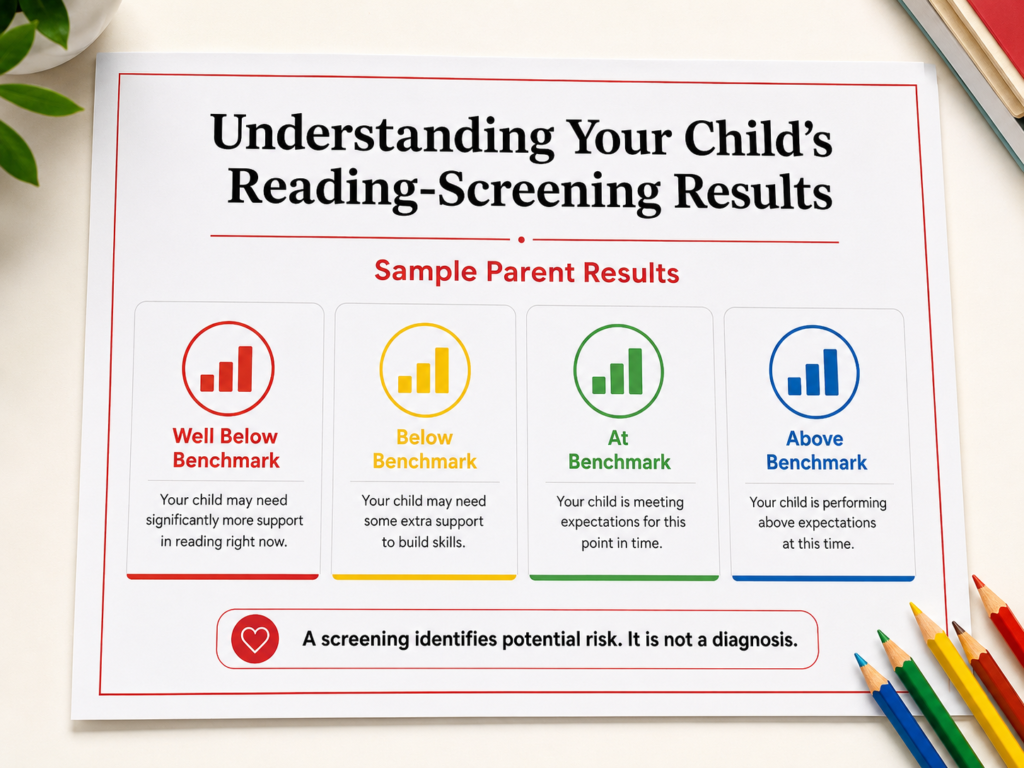
Understanding Your Child’s Results
Your child’s overall score will fall within one of four performance levels:
- Well Below Benchmark (red): Your child needs intensive reading support and additional practice.
- Below Benchmark (yellow): Your child needs strategic reading support and additional practice.
- At Benchmark (green): Your child is currently on track to meet grade-level reading expectations.
- Above Benchmark (blue): Your child is currently on track to meet or exceed grade-level reading expectations.
Some first- and second-grade students may also receive a designation indicating that they are either at risk or at low risk for potential reading difficulties.
What Does “At Risk” Mean?
An at-risk result does not mean that your child has been diagnosed with dyslexia or a learning disability. A reading screener is designed to identify students who may need closer monitoring, additional instruction, or further evaluation.
The screening results provide an important starting point, but they may not explain:
- Which specific reading skills are difficult for your child
- Why your child is struggling
- Whether the difficulty is temporary or persistent
- What type and intensity of instruction your child needs
- Whether your child demonstrates a reading profile associated with dyslexia
Questions to Ask Your Child’s School
If your child scores below or well below benchmark, consider asking:
- Which specific reading skills were difficult for my child?
- What reading intervention will be provided?
- How frequently and for how long will the intervention occur?
- Will the instruction be explicit, systematic, and evidence-based?
- How will my child’s progress be measured?
- When will the results and progress be reviewed with me?
- What will happen if my child does not make sufficient progress?
When Should Parents Consider an Educational Evaluation?
An educational evaluation may be helpful when:
- Screening results show that your child is below or well below benchmark.
- Your child continues to struggle despite receiving additional instruction.
- There is a family history of dyslexia or other learning differences.
- Your child has difficulty sounding out words, reading accurately, spelling, or developing reading fluency.
- School results do not fully explain your child’s learning needs.
- You need clear recommendations for instruction and intervention.
A comprehensive educational evaluation looks beyond a single screening score. It helps identify your child’s areas of proficiency, areas for growth, and specific instructional needs.
Understanding the Results Is the First Step
Early identification and appropriate intervention can make an important difference in a child’s reading development. Parents should not be expected to interpret screening scores alone.
Milestones Educational Therapy provides individualized educational evaluations to help families understand how their child learns, identify specific academic needs, and determine appropriate next steps.
Morning appointments for comprehensive educational evaluations are currently available. Contact Milestones Educational Therapy to request a complimentary consultation.
For additional information about the LAUSD Reading Difficulties Risk Screener, visit the LAUSD Reading Difficulties Risk Screener resource page.
Related Posts
-
Beginning in the 2025–2026 school year, California public ...
Sorry, the comment form is closed at this time.